Observing the Market
Stories about how markets really behave.
An editorial look at market behavior.
Sometimes the story doesn’t add up.
A company publishes strong results and is punished that same day. Not because anything is wrong — but because it was already expected.
Another company trades at an all-time high. Revenue is falling. Profit is falling. And yet the price keeps rising. Two hundred times earnings.
If you watch this long enough, something feels strange: it doesn’t feel like you missed a crucial detail, but as if you’ve been listening to the wrong story.
At some point I noticed that making decisions was getting harder.
So I stopped.
Not my interest — just my participation.
I started watching. From a distance.
What stands out when you take that distance is not how complex the market is, but how small the playing field turns out to be.
The same movements.
The same reactions.
The same forces.
The game has been played for decades under almost the same rules. Only the stories wrapped around it keep changing.
Because behind every move, the same forces keep returning.
Observing the Market doesn’t try to predict what will happen. It is a place to watch — without judgment — what keeps happening again and again.
Not opinions.
But behavior.
They change shape, name and context — but they never disappear.
The large capital that has to act.
The investor who waits for reason to return.
The opportunist who finds confirmation in movement.
And the systems that, without emotion, amplify what has already been set in motion.
In the stories on this site we give those forces a face. Not to pin them down, but to recognize them faster when they appear again.
These are the four main characters that return in every story.
Read slowly. These stories work best with distance.
This is not a site for quick wins.
Nor is it for people trying to beat the market.
Observing the Market is for people who invest their own money, often for some time already, and who take that money seriously.
You’re not managing millions, but it isn’t play money either. We’re talking about amounts that matter — roughly between five and fifty thousand euros.
Sometimes it’s only your own capital. Sometimes it includes money for your children, or for later. You want to handle it responsibly.
You’re not looking for adrenaline. You’re looking for calm.
Not necessarily the maximum possible return, but more than what the bank offers. You want to see that it’s working. That, over time, the money slowly grows.
You follow the news. Sometimes general, sometimes financial. You look at prices, charts, patterns.
You understand the story… and yet it often feels as if you’re just slightly off.
This is not a place to fix that. But it is a place to put it into perspective.
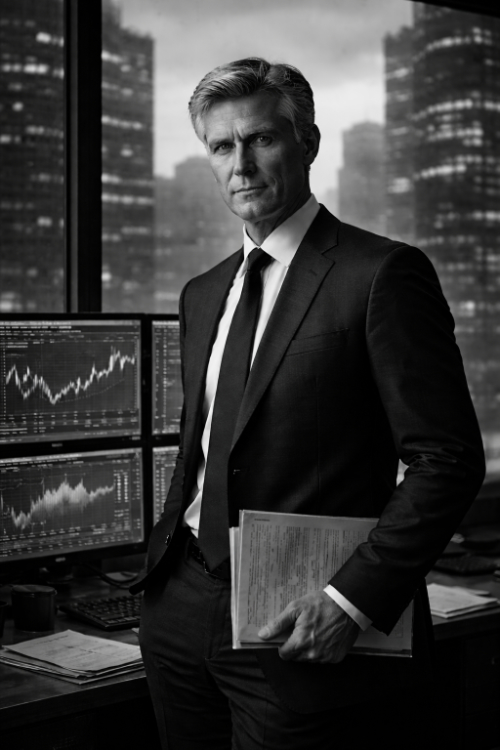
Mr Ashcroft
The face of large capital in the market
Mr Ashcroft is not a single person, but a force. He represents the large pools of capital that have to act: pension funds, hedge funds, and asset managers moving billions to meet obligations years into the future.
He doesn’t invest to achieve the highest score. His mandate is to keep capital functioning: protect purchasing power, keep risk within agreed limits, adjust weightings as positions grow too large.
From the outside, all you see is a price that moves. In Mr Ashcroft’s world, it’s routine: scaling down, reallocating, reducing pressure. Not spectacular, but decisive.
In the stories on this site, he keeps reappearing — often off-screen, as the force behind the price.
Elliot
The voice of reason.
Elliot represents the investor who wants to understand what he’s doing. For whom a price has to rest on something: revenue, profit, growth — something that supports the story.
When prices seem to detach from that foundation, he becomes cautious. Not out of fear, but out of experience. He has seen this before.
Elliot tends to take profits relatively early. Not because he needs to be right, but because he knows how quickly conviction can flip. Better to miss a little than to be too late again.
In the market, he is often early. In his analysis, often right. Just rarely at the moment that counts.
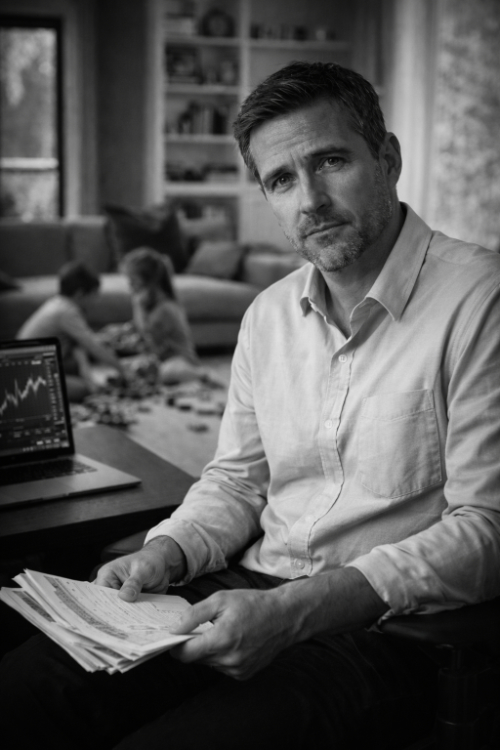

The Computer
Order without opinion.
The Computer does not represent a person, but automated trading: algorithms, high-frequency systems, and models that execute orders without human judgment in between.
No emotions. No convictions. Only rules that are executed once they are triggered.
It rarely causes movement. But it makes what is already there: larger — more consistent — more rhythmic.
In the world of observation, the Computer is discipline without context. Always reacting. Never explaining.
Marcus
Seeing opportunity where others mainly see risk.
Marcus doesn’t look at what something is worth today, but at what it could become.
Where others see an all-time high and pull back, he steps forward.
He enters when the story feels bigger than the price and stays as long as momentum remains intact.
In the stories on this site, Marcus appears in the forward motion: the moments when the market has already moved on, while the arguments are still catching up.

Story 1
After the numbers
The story
The company releases its quarterly results. Revenue up. Profit up. The outlook remains unchanged.
Before the open, the stock trades higher. After the bell, the price starts to fade. Slowly. Steadily. No panic. No headlines. Just selling.
Commentators search for language. Priced-in expectations. On forums, confusion.
You look at the numbers. And at the price. They don’t seem to recognize each other.
Behind the scenes
Mr Ashcroft is selling. Not everything. Not today. He has held the position for some time. It has simply grown too large.
Elliot sees the numbers. They make sense. He waits. The market will understand.
Marcus buys the first dip. It feels illogical. That reassures him.
The Computer sees no numbers. Only direction. Only volume. The pressure builds.
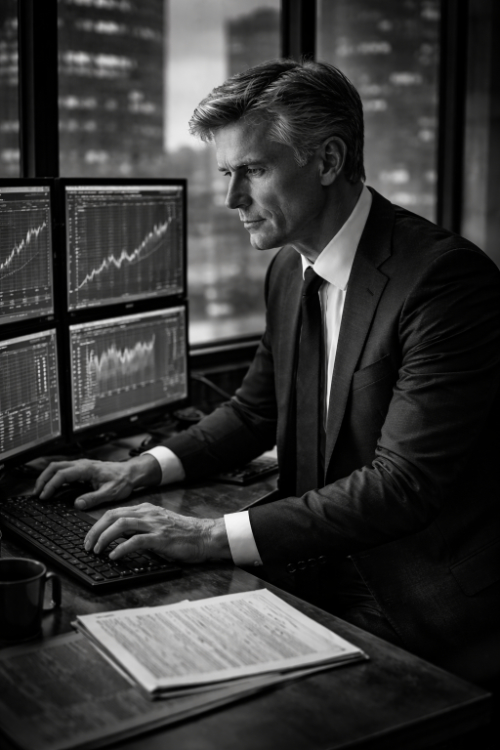
When you zoom in
On days like this, attention moves to the numbers. But the price doesn’t respond to how good something is. It responds to who has to act.
For those watching only the news, the market can feel absent. Or wrong. But trading is very much taking place. Just outside your field of view.
Some positions are not sold out of doubt, but out of necessity. Not because the story changes, but because the weighting demands it.
That doesn’t happen in a single move. It seeps through. Day after day.
For insiders, this is routine. Not exciting. Not emotional. Just work.
The numbers did what they needed to do. The market did too.
Story 6
Close enough
The story
A stock has had a long run. No spectacular hype, no forum frenzy — just years of steady growth. The numbers are stable, the outlook is restrained, the valuation has crept up gradually.
In the run-up to the latest earnings release, the pace begins to pick up. The price moves ahead of the story. Analysts raise targets, commentary turns slightly more enthusiastic than the numbers themselves.
One afternoon the price touches the level you once wrote down as: reasonable, but not cheap. Not absurd. Not dangerous. Simply: close enough.
The numbers arrive. No surprises. Everything more or less as expected. You reduce your position. Not out of fear, but out of discipline.
Behind the scenes
Mr Ashcroft scales down. Not because the story breaks, but because the position has grown too large.
Elliot sees no errors in the numbers, but no room for comfort either.
Marcus sees momentum. For him, this is where it really begins.
The Computer amplifies what is already happening. Direction and volume are enough.

When you zoom in
From a distance, the difference between “too early” and “just right” looks like a matter of timing. The market moves, and you try not to be too late — or embarrassingly early.
Up close, it often turns into a different question: how much room do you allow yourself between reason and greed?
Elliot doesn’t look for the highest possible price. He looks for the zone that lets him sleep. A range in which he can say: this is defensible, even if the outcome turns out differently in hindsight.
Marcus lives in the margins beyond that zone. For him, tension is part of the story. As long as the price can keep moving, “close enough” mostly feels like too early.
Mr Ashcroft operates another layer above that. He can afford to be rational and slow. Not because he is smarter, but because his horizon is set by obligations, not by the next quarter.
For those who only look at the chart, the story seems simple: too early or too late. But those who act like Elliot shift the question from being right to being able to live with the outcome.
Sometimes “close enough” is not missed profit, but a chosen distance.
Story 11
It works, so it must be right
The story
It starts innocently. The price has been rising for a few weeks, but without spectacle. No panic, no euphoria. Just a steady climb, as if everyone quietly agrees that this makes sense.
Then the tone shifts. Not in the numbers, but in the conversations. Analysts become more assertive. Commentary moves from “interesting” to “promising.” Sentences get shorter. More certain.
Marcus appears exactly there. Not as a person, but as a posture. He doesn’t point to risk, but to what is still possible. To everything you might miss if you don’t move along now.
The price is higher than you’re comfortable with, but lower than Marcus finds logical. That gap suddenly feels larger than it really is.
Behind the scenes
Marcus increases his exposure. Not with numbers, but with assumptions. Each success becomes confirmation, each rise proof that the story isn’t finished yet.
He doesn’t use models, but examples. “It went the same way last time.” “This feels familiar.” Recognition works faster than analysis.
The Computer helps him unintentionally. Momentum strategies amplify what is already moving. Volume attracts volume. Direction turns into truth.
Doubt doesn’t disappear, but it gets less airtime.

When you zoom in
From a distance, Marcus looks like a person. Up close, he is a force field. Made of conviction, speed, and comparison.
Marcus doesn’t force you to buy. He simply makes it harder not to. By nudging the bar a little higher each time: what felt expensive yesterday feels reasonable today.
For Elliot, that is the breaking point. Not because he is wrong, but because his range is narrower. What feels like room to Marcus feels to Elliot like a position asking too much.
Mr Ashcroft sees something else. He recognizes Marcus as a phase, not a truth. For him, this is not a signal, but a symptom of a cycle that has returned many times before.
Marcus rarely leaves with noise. Most of the time, he just keeps moving, until the room quietly empties.
The question is not whether Marcus will be right. The question is how much room you give him before he starts setting your pace as well.
Story 16
Without an opinion
The story
The day starts calmly. The stock opens slightly higher than yesterday, volume is normal, the first minutes unfold in an orderly way. The order books are filled, but not tense.
Then the headline appears. The results are “in line with expectations”, revenue grows modestly, profit a bit less, the outlook sounds cautious. No blockbuster, no disaster. Sober, almost dull.
Yet within seconds the price drops sharply. Bid levels disappear, offers slide away, the chart draws in a few ticks what would normally take half a day. As if someone flipped a hidden switch.
You’re looking at the same news as everyone else. You reread the paragraphs, searching for a sentence that explains the move. But while you’re still reading, the chart is already two steps ahead.
Behind the scenes
The Computer doesn’t read a story, but rules. It scans words, compares expectations, weighs surprises down to the decimal. Not in minutes, but in milliseconds.
As soon as the first orders shift, other systems respond. Market makers pull their quotes, algorithms reduce positions, momentum strategies latch onto the new direction.
Where you see a single price, the Computer sees thousands of small adjustments: stop losses waiting in the book, options that suddenly need to be repriced, ETFs that must breathe with the index.
It doesn’t need an opinion on the company. It’s enough that the rules say: less risk, more speed, step back in line.

When you zoom in
From a distance it can look as if one large player hits the sell button. As if someone decides: that’s enough. But up close you see something else: countless small decisions, all tipping in the same direction at the same moment.
The Computer doesn’t think about “fair value.” It knows no doubt and no regret. It executes a chain of conditions: if this number deviates, then reduce risk; if volume accelerates, then move faster; if liquidity thins, then step further back.
Each rule makes sense on its own. Combined, they create movements that feel like panic to a human. Not because anyone is frightened, but because the sum of caution looks like fear.
Marcus mainly sees opportunity. For him, acceleration is the signal: something is happening here. He tries to catch the jump before calm returns and the chart thins again.
Elliot often sees the opposite. Where the Computer amplifies, he looks for places where the story hasn’t fundamentally changed, but prices behave as if it has. For him, the question isn’t whether the move is logical, but whether he can live with not being involved everywhere.
Mr Ashcroft looks another layer further out. To him, these are ripples in a much longer line. He doesn’t ask who is right today, but what this day means in a report spanning years.
At the next headline, the Computer will do what it always does: read, measure, act. Without story, without memory, without shame.
For anyone watching, one question remains: do you live at the Computer’s speed, or do you consciously choose a different timescale?
Table of contents
Observing the Market
Mr Ashcroft
Capital that has to move
- After the numbers
- When everything is already decided
- Too big to do nothing
- Selling without doubt
- The quiet shift
Elliot
Reason in a moving market
- Close enough
- It makes sense, but not yet
- Right too early
- After confirmation
- What feels logical
Marcus
Movement as conviction
- It works, so it must be right
- Beyond every expectation
- Everyone sees it now
- Late, but not too late
- As long as it keeps going
The Computer
Rules without context
- Without an opinion
- When direction is enough
- Following without doubt
- Accelerating what was already there
- Until it stops
These stories are part of the ebook Observing the Market. The ebook is regularly updated with new situations.
If you’d like to stay informed about new versions — or order the ebook — you can find it here.
Which situation is still missing?
These stories are part of the ebook Observing the Market. The ebook is regularly expanded with new situations.
We’re curious what you run into. Which situations you recognize most often, which forces are at play, and which story you feel is still missing here.
Below, you can describe a situation you frequently see returning in the market. We read along, without judgment.